
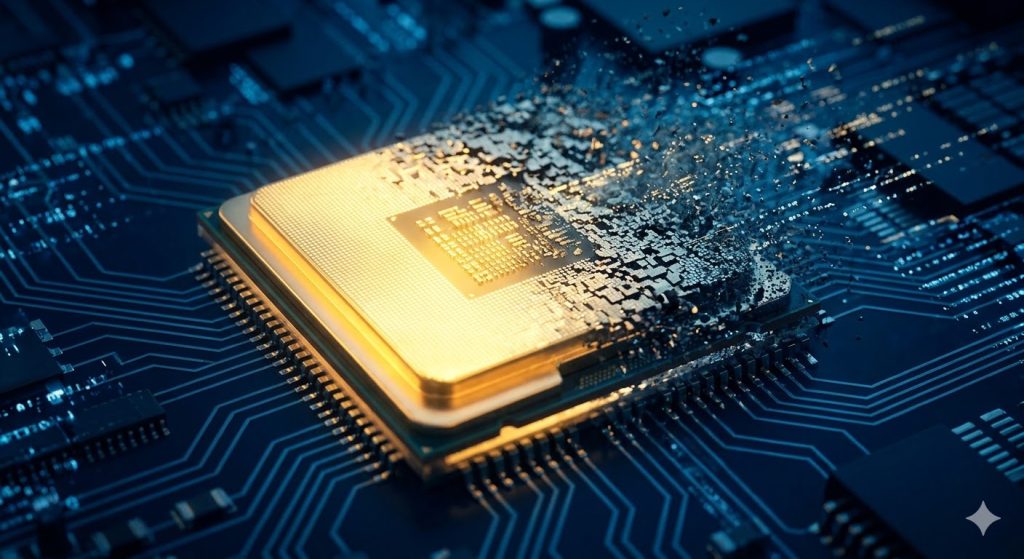
The Silicon Sunset
Is Moore’s Law Finally Dead, or Just Reincarnated?
For over half a century, the heartbeat of the modern world was a simple observation made by Gordon Moore: the number of transistors on a microchip doubles approximately every two years. This wasn’t just a technical metric; it was a prophecy that fueled the rise of the smartphone, the internet, and the AI revolution. But as we venture further into 2026, the industry is whispering a heresy: the “Silicon Sunset” is finally upon us.
The problem is fundamental physics. We have shrunk transistors down to the size of a few atoms. At this scale, we encounter “quantum tunneling,” where electrons literally leap across barriers they aren’t supposed to cross, causing chips to overheat and malfunction. We can no longer simply make things smaller to make them faster. For the first time in history, the exponential growth of raw computing power is hitting a physical wall.
However, the end of Moore’s Law isn’t the end of progress—it’s the beginning of the “Architecture Era.” Engineers are shifting their focus from size to structure. We are seeing the rise of 3D chip stacking, where processors are built upward like skyscrapers rather than sprawling out like suburbs. Furthermore, specialized AI chips (NPUs) are replacing general-purpose processors, doing more work with less energy by focusing solely on neural network mathematics.
The most exciting—and volatile—frontier is Quantum Computing. While still in its nascent stages for consumer use, 2026 has seen breakthroughs in “error correction” that suggest we might soon bypass silicon entirely for complex simulations.
For the average consumer, this means the days of buying a new phone every year for a “speed boost” are over. Future gains will come from smarter software and cloud integration. The “Silicon Sunset” might sound dark, but it is actually forcing the industry to be more creative than it has been in decades. We are moving away from the brute force of hardware and into an era of elegant, specialized efficiency. The race isn’t over; the track has just changed.