
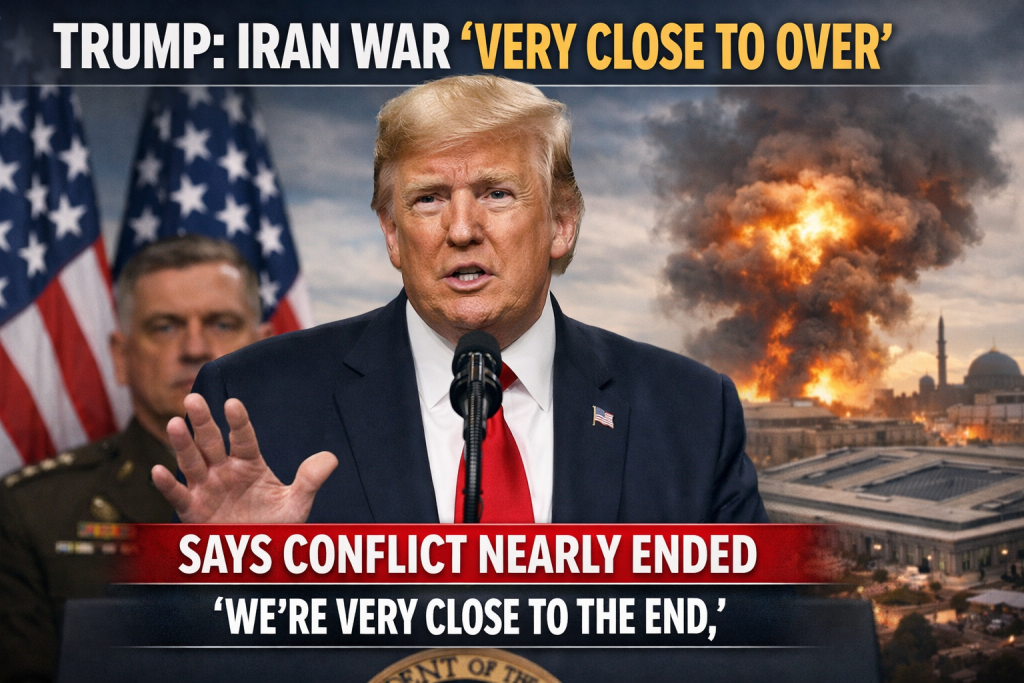
Trump Says He Views Iran War as ‘Very Close to Over’
Brink of Peace or New Blockade? Decoding Trump’s “Very Close to Over” Iran Strategy
WASHINGTON D.C. — In an exclusive interview with Fox Business’s Maria Bartiromo that aired on April 15, 2026, President Donald Trump declared the high-stakes conflict with Iran to be “very close to over.” The statement comes just seven weeks after the commencement of Operation Epic Fury, a military campaign that has fundamentally reshaped the geopolitical landscape of the Middle East.
While the President struck a triumphant tone, the reality on the ground—and at sea—suggests a complex transition from active combat to a high-pressure diplomatic “squeeze play” that continues to shake global markets.
The Strategic Impact of Operation Epic Fury
Since the initial joint U.S.-Israeli strikes on February 28, the Iranian military has faced unprecedented degradation. President Trump’s characterization of the war in the “past tense” during his conversation with Bartiromo reflects a belief that the U.S. has achieved its primary objectives: crippling Tehran’s nuclear ambitions and limiting its regional military reach. “If I pulled up stakes right now, it would take them 20 years to rebuild,” Trump remarked, suggesting the regime’s power projection is effectively dismantled.
A Naval Blockade Replaces Air Strikes
Despite the talk of peace, the administration has pivoted to a new form of kinetic diplomacy. On Monday, April 13, the U.S. Navy officially began a focused blockade of Iranian ports. Directed by CENTCOM, the operation aims to halt all economic trade going into and out of Iran by sea. While some tankers continue to attempt transit through the Strait of Hormuz, the U.S. military reports that over 10,000 personnel and a dozen warships are now enforcing the blockade to maintain pressure on Tehran.
The Islamabad Stalemate
The diplomatic road to a final settlement has hit significant turbulence. Over the weekend of April 11–12, Vice President JD Vance led a delegation to Islamabad, Pakistan, for the most direct U.S.-Iran contact in decades. The marathon 21-hour session ended without a definitive peace deal after the U.S. demanded the total termination of Iran’s nuclear program—a term Iranian Parliament Speaker Mohammad Bagher Qalibaf rejected. Despite the stalemate, Trump told the New York Post on Tuesday that a second round of talks could resume within the next 48 hours.
A Fragile Ceasefire Holds
A Pakistani-brokered two-week ceasefire, which went into effect on April 8, remains the only thread preventing a return to full-scale sorties. While the U.S. has moved forward with its naval blockade, the pause in air strikes and ground skirmishes has allowed a window for diplomacy. This window is set to expire on April 22, placing immense pressure on Islamabad to facilitate a breakthrough before the clock runs out.
The Lebanon Breakthrough
In a historic parallel development, senior diplomats from Israel and Lebanon met face-to-face in Washington on April 14 for the first time since 1993. Mediated by Secretary of State Marco Rubio, the meeting between ambassadors Yechiel Leiter and Nada Hamadeh Moawad was described as “productive.” While Hezbollah has rejected the legitimacy of these talks, the summit signals a regional shift as the Lebanese government seeks a permanent ceasefire and a delineating of borders, independent of the broader Iran conflict.
Sources:
- Investing.com (April 14, 2026): “Trump sees Iran war as ‘very close to over’ – Fox’s Bartiromo.”
- Bernama/Anadolu Agency (April 15, 2026): “Trump Says Iran War Is ‘Close To Over’.”
- Wikipedia (April 15, 2026): “Naval blockade of Iran” (citing The Washington Post, BBC News, and Times of Israel).
- CTV News/Associated Press (April 11, 2026): “U.S. Vice President JD Vance says talks with Iran have ended after 21 hours.”
- The Washington Post (April 14, 2026): “Lebanese, Israeli diplomats hold rare face-to-face meeting in Washington.”
- CBS News Live Updates (April 15, 2026): “Trump says Iran war ‘close to over’ as Pakistan pushes for new peace talks.”