
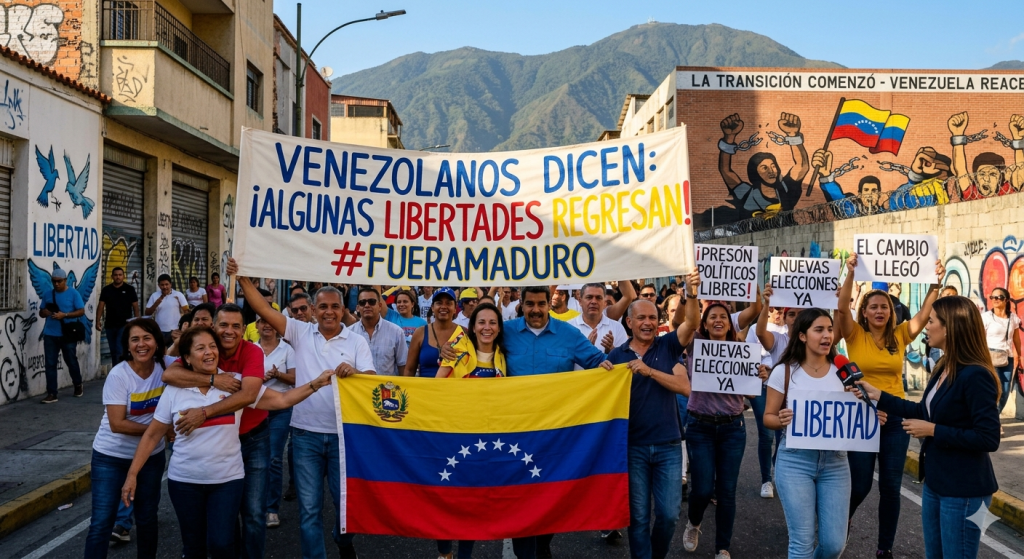
Venezuelans Say Some Freedoms Returned Since Maduro Ouster
Following the dramatic ouster of Nicolás Maduro on January 3, 2026, Venezuela has entered a complex and fragile period of transition. While Acting President Delcy Rodríguez remains in power, the atmosphere in Caracas and beyond has shifted as the country begins to dismantle years of restrictive policies.
Here are five additional major updates on the situation as of April 15, 2026:
Over 650 Political Prisoners Released
Human rights organizations have verified the release of at least 659 political prisoners between January and March. Those freed include high-profile journalists, human rights defenders, and opposition figures who were detained during the Maduro administration. While many celebrate these releases, activists note that hundreds more remain in custody and those freed often still face legal “gag orders” preventing them from speaking to the press.
Mass Amnesty Law Passed
In late February, the Venezuelan legislature unanimously adopted a landmark Amnesty Law. Acting President Rodríguez hailed the move as a step toward “healing from hatred.” The law covers a range of charges previously used to target dissidents; however, opposition leaders have criticized the legislation for being too narrow, as it currently excludes military offenses and certain “coup-related” charges used against Maduro’s rivals.
Opposition Calls for New Elections
On April 11, 2026, the Venezuelan opposition, led by Maria Corina Machado’s Vente party, officially called for new presidential elections. They argue that the 90-day legal deadline to choose a successor to Maduro has expired. Under Article 234 of the Constitution, the opposition is pushing the National Assembly to declare Maduro’s absence permanent and trigger a vote within 30 days.
Reopening of International Diplomatic Channels
There are significant signs of a “thaw” in Venezuela’s relations with the West. The European Union has recently considered lifting sanctions on members of the interim government, and the United Nations Human Rights Office is in active talks to reopen its mission in Caracas after being expelled in 2024. This international re-engagement is seen as a crucial step for the country to access frozen assets and humanitarian aid.
Exiles Begin Cautious Returns
Following the announcement of the amnesty law, Acting President Rodríguez has invited the estimated seven million Venezuelan exiles to return home. While some flights have seen a trickle of returnees—mostly those looking to reclaim property or reunite with family—many remain skeptical. Exiles in Colombia and Peru report that while “the head of the regime is gone,” the underlying military and bureaucratic structures of the old government remain largely unchanged.
Sources:
- WOLA (March 11, 2026): “Two months without Maduro in Venezuela: Democratic transition or authoritarian adaptation?”
- Al Jazeera (February 4, 2026): “Exiled Venezuelans dream of returning home. What’s stopping them?”
- Arab News (February 24, 2026): “Venezuela says exiles welcome to return following mass amnesty.”
- Qatar News Agency (QNA) (April 11, 2026): “Venezuelan Opposition Calls for New Presidential Elections.”
- Wikipedia/ReliefWeb (April 2026): “2026 United States intervention in Venezuela & Migration Implications.”