
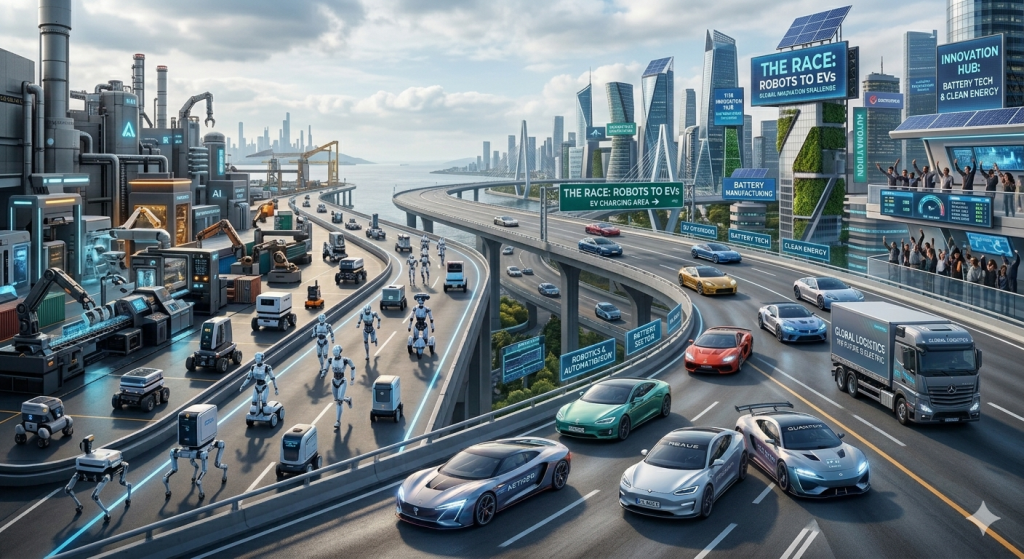
The race: From robots to EVs
In a two-storey flagship laboratory in one of the many new business hubs in Chongqing, a group of kindergarten children cackle with delight as they watch a robot fish swim around the tank.
Other humanoid robots come to life and show off their kung-fu or funky dance moves. The children are eager to show off to the BBC cameras and the teacher helps them practise their English by making them repeat in unison: “This robot can dance!”
China already has the largest number of industrial robots in its factories, and the state plans to invest around $400bn in robotics this year alone.
Chongqing, which finds itself at the heart of this investment, aims to become the Silicon Valley of western China. But here and across the country, Chinese robotics may need American help.
Robots need a fast-working brain and that’s why China is keen to buy more high-end AI chips from the US firm Nvidia. This could be a sticking point in this week’s meeting.
In 2022, the Biden administration tried to arrest Chinese AI and robotics by denying it cutting-edge semiconductors. President Trump has relaxed that policy. Last year, he cleared the way for Nvidia to begin selling some of its advanced chips to China but not the most advanced ones.
As China and the US fight for technological supremacy, analysts believe there is a bigger concern at hand with the rise of AI.
Some fear that one bad actor with a laptop in a bunker anywhere could hack health services, or find nuclear launch codes, and argue that this is a moment for both leaders to think about the greater good, rather than the great power competition.