
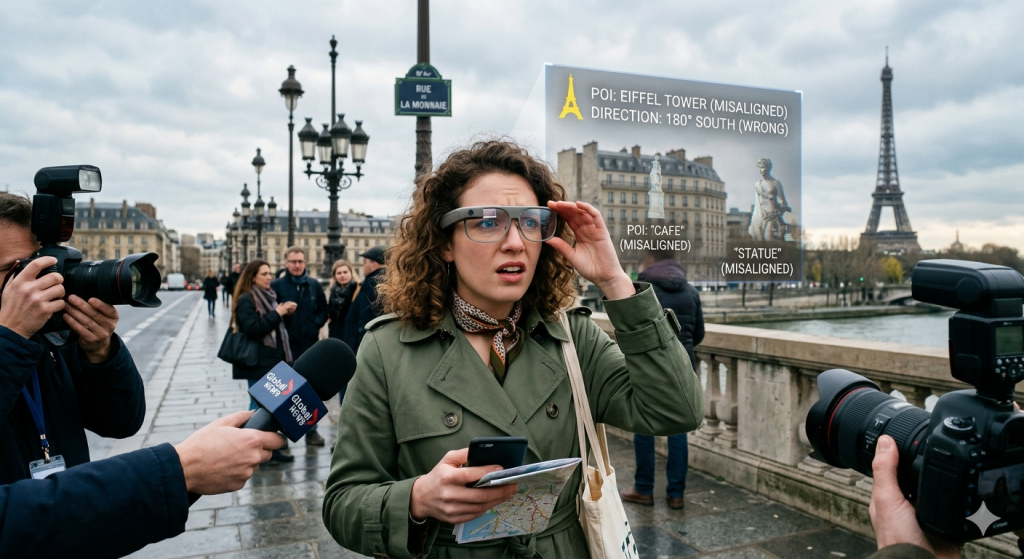
I tested AI glasses in Paris. Here’s what they got wrong
Artificial intelligence-powered smart glasses have been promoted as the next major step in consumer technology, promising to combine cameras, voice assistants, translation tools, and real-time information into a device that can be worn all day. Technology companies including Meta and other manufacturers believe AI glasses could eventually replace many smartphone functions. However, a recent hands-on test in Paris highlighted that while the technology is impressive, it still makes significant mistakes and is far from perfect.
Walking through the streets of Paris, the AI glasses were asked to identify landmarks, translate signs, and answer questions about the surrounding environment. In some situations, the glasses performed remarkably well. They could identify famous attractions, provide quick historical information, and translate simple text from French into English. The hands-free experience also made it possible to obtain information without looking at a phone screen.
However, the test also exposed several weaknesses. One of the biggest problems was inaccurate identification of objects and locations. In some instances, the AI confidently described buildings incorrectly or provided information about places that were not actually in view. Similar issues have been reported by users and reviewers who say AI glasses sometimes identify one object as another entirely, creating a misleading sense of reliability.
Translation functions also struggled with context. While the glasses could handle simple signs and short phrases, more complex expressions and colloquial language occasionally produced awkward or incorrect translations. In a city like Paris, where tourists frequently depend on translation tools, even minor errors can lead to confusion when reading menus, understanding directions, or interpreting important information.
Another issue was response speed. The glasses sometimes took several seconds to answer questions, creating awkward pauses during use. At times, they failed to respond entirely or required repeated commands. Similar problems have appeared during public demonstrations of AI glasses, including highly publicized instances where smart-glasses systems failed to answer basic questions or complete simple tasks.
The technology also showed signs of what AI experts call “hallucinations.” This occurs when artificial intelligence systems generate answers that sound plausible but are factually incorrect. During demonstrations of smart glasses, systems have described scenes that were not present or provided incorrect details about visible objects. Such errors raise concerns because users may trust the information simply because it is delivered confidently and in real time.
Privacy concerns represented another major issue during the Paris test. Because the glasses contain cameras and microphones, bystanders often do not know when they are being recorded or analyzed by artificial intelligence systems. Some reviewers have said wearing the glasses made them feel uncomfortable or intrusive, especially in crowded public spaces where people may not realize they are interacting with someone wearing an AI-powered recording device.
Battery life and reliability also remain challenges. Users have reported that certain AI functions significantly reduce battery performance and that voice assistants occasionally stop working or deliver incomplete answers. Some visually impaired users who hoped the glasses would serve as assistive devices have found that inaccurate descriptions and system glitches limit their usefulness in critical situations.
Despite these shortcomings, AI glasses still demonstrate considerable potential. The ability to access information, capture photos, receive directions, and interact with an AI assistant through a pair of glasses represents a significant technological achievement. Industry analysts believe the technology will improve rapidly as artificial intelligence models become more accurate and hardware becomes smaller and more efficient.
The Paris test ultimately showed that AI glasses are both exciting and imperfect. They can provide useful assistance and glimpse a future where computing becomes more integrated into daily life. At the same time, they continue to make basic mistakes, misunderstand context, and raise important questions about privacy and reliability. For now, the technology remains more of an intriguing preview of the future than a fully dependable replacement for the smartphone.