
AI will create more jobs for humans, not replace them, Amazon founder Bezos says
PARIS — Dismissing the bleak economic forecasts that have dominated Silicon Valley, Amazon founder Jeff Bezos fired back at predictions of a looming AI-driven employment apocalypse, arguing instead that the booming technology will trigger a widespread labor shortage by creating far more work for humans than it displaces.
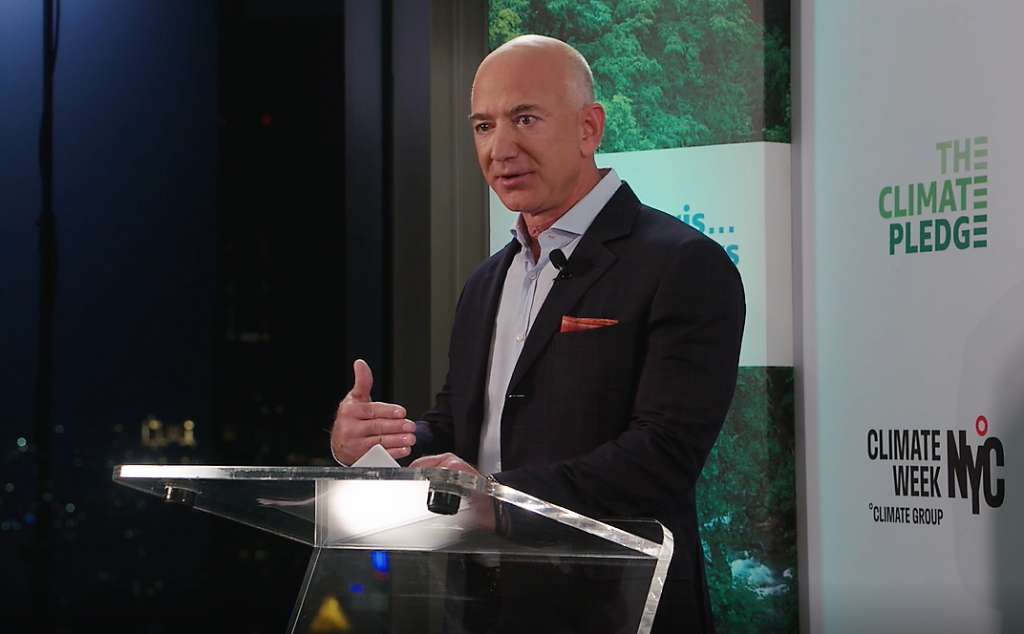
Speaking at Europe’s VivaTech conference, Bezos rejected the notion that artificial intelligence will render the human workforce redundant. “The people who are jumping to the conclusion that the jobs are all going to go away… I think these people are just wrong,” Bezos stated. “At root, all civilisational wealth is driven by invention. Six thousand years ago, somebody invented the plough, and we all got wealthier.”
The “Bulldozer” Productivity Shift
Instead of leaving swaths of the population unemployed, Bezos layout an optimistic economic theory focused on exponential productivity gains. He compared handing AI tools to a modern workforce to giving construction workers a bulldozer instead of a handheld shovel.
Under this model, the technology doesn’t eliminate the worker; rather, it exponentially scales the volume and sophistication of what a single worker can achieve. When individual human output increases so dramatically, corporate ambitions grow with it. Consequently, businesses expand their project pipelines, creating an aggregate demand for more human labor to manage the massive influx of newly viable operations.
Bezos even speculated that these massive productivity spikes could rewrite household economics, potentially making single-income households financially viable again as individual earners generate substantially higher baseline economic value.
Scaling Prometheus, the “Artificial General Engineer”
The billionaire’s rosy economic outlook coincided with a massive financial update for his latest operational venture. Bezos announced that Prometheus—the highly secretive AI startup he launched last November with former Google executive Vikram Bajaj—has successfully raised a staggering $12 billion Series B funding round.
Backed by institutional heavyweights including JPMorgan Chase and BlackRock, the capital injection rockets Prometheus’s valuation to $41 billion, a historic milestone for a firm boasting roughly 150 employees spread across San Francisco, London, and Zurich.
Prometheus Valuation (June 2026): $41 billion
Fresh Capital Raised: $12 billion Series B
Total Capital Pool to Date: $18.2 billion
Core Mission: Constructing an "Artificial General Engineer"
Unlike popular consumer products built on large language models (LLMs) that primarily manipulate text and code, Prometheus is training its systems on real-world data to master physical laws and physics. The ambition is to build an “artificial general engineer” capable of drastically compressing heavy manufacturing pipelines and removing the need for costly physical prototyping. To fuel this model, Bezos is reportedly raising an additional $100 billion holding fund to purchase strategic stakes in traditional heavy industrial firms.
A Deeply Divided Silicon Valley
Bezos’s sweeping optimism stands in stark contrast to a deeply polarized tech sector. The remarks come at a tense moment: U.S. employers tied 40% of the 97,006 job cuts announced in May directly to AI efficiencies, and Amazon itself has cut roughly 30,000 corporate roles since late last year. Critics point out that billionaires heavily invested in commercializing AI tools have distinct financial incentives to paint a comforting picture for the public.
Furthermore, other prominent AI pioneers remain aggressively bearish. Just this week, Anthropic CEO Dario Amodei published a dense, 10,000-word essay warning that advanced systems will rapidly decimate white-collar employment. Amodei explicitly proposed raising capital gains taxes to fund universal basic income (UBI) frameworks to cushion society against an imminent jobs apocalypse.
Yet, for Bezos, the path forward is supply-constrained, not demand-constrained. Whether designing reusable rockets at Blue Origin or automating factories via Prometheus, he insists humanity’s capacity to build will remain limited only by the number of human hands available to direct the machines