
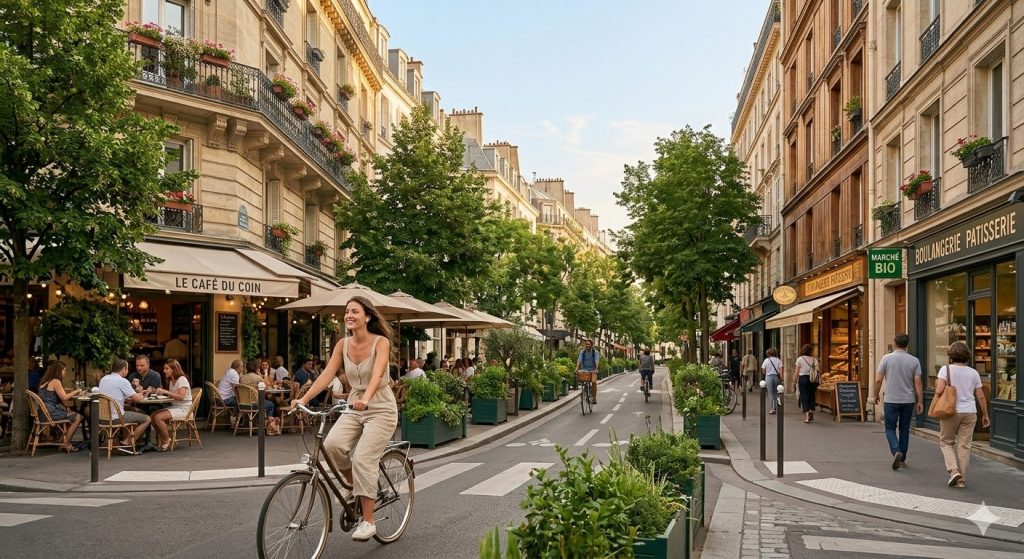
The 15-Minute City
Urban Utopia or the End of Personal Freedom?
Imagine waking up and knowing that everything you need for a high-quality life—your office, your doctor, a fresh grocery market, and a lush park—is within a 15-minute walk or bike ride from your front door. This is the “15-Minute City,” a concept that has migrated from urban planning textbooks to the center of a heated global debate in 2026.
Proponents argue that this model is the ultimate cure for the “loneliness epidemic” and the climate crisis. By eliminating the soul-crushing hour-long commute, we reclaim time for family, exercise, and community engagement. Cities like Paris and Barcelona have already begun carving out “superblocks,” reclaiming asphalt from cars and handing it back to pedestrians and planters. The result? Lower CO2 emissions, quieter streets, and a measurable boost in local economic activity.
However, the transition hasn’t been without friction. Critics view the 15-minute city through a more cynical lens, fearing it is a precursor to “climate lockdowns” or a way to restrict freedom of movement. Some argue that by hyper-localizing our lives, we risk creating “echo-chamber neighborhoods” where we never interact with people outside our immediate socio-economic circle.
The reality likely lies in the middle. The 15-minute city isn’t about trapping people in their neighborhoods; it’s about providing the option to stay. It challenges the 20th-century obsession with the automobile, which forced us to design cities around engines rather than humans.
As we look toward the rest of the decade, the success of this movement will depend on equity. If 15-minute neighborhoods only exist in wealthy zip codes, they become gated communities without gates. But if implemented across the board, they offer a blueprint for a slower, more intentional way of living—one where the “spirit” of the traveler is nourished by the beauty of their own backyard.