
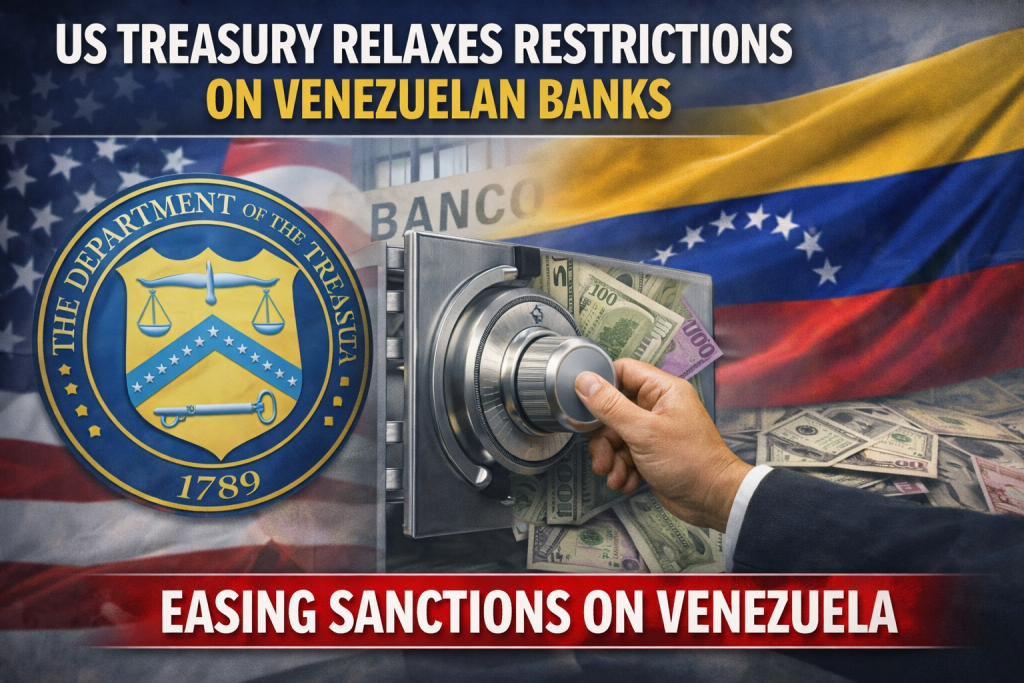
US Treasury Relaxes Restrictions on Venezuelan Banks
As of April 15, 2026, Venezuela remains in a high-stakes transition following the January 3rd ouster of Nicolás Maduro. While the “iron fist” of the previous decade has loosened, the country is now grappling with the legal and political vacuum left behind.
Here are 5 major new developments regarding the return of freedoms and the transition:
Opposition Formally Declares “Absolute Absence” of Maduro
On April 11, 2026, the Vente party, led by Maria Corina Machado, officially invoked Article 234 of the Constitution. They argue that because Maduro has been in U.S. custody for over 90 days, his absence is now “permanent.” The opposition is demanding that the National Assembly trigger a 30-day countdown to hold new presidential elections, challenging the interim leadership of Delcy Rodríguez to set a date immediately.
Amnesty Law Hits “Implementation Wall”
While the Mass Amnesty Law passed in February was hailed as a breakthrough, human rights groups like Amnesty International reported on April 14 that its application remains “arbitrary.” Critics argue that judges are using discretionary criteria to keep high-ranking military dissidents behind bars while releasing lower-profile activists. As of this week, over 620 political prisoners have been freed, but roughly 500 remain in custody.
U.S. and Venezuela Re-establish Diplomatic Ties
For the first time since 2019, the U.S. and Venezuela have agreed to a gradual normalization of diplomatic and consular relations. This “strategic reset” aims to facilitate the return of thousands of citizens and provide a formal channel for the transitional government to coordinate with Washington. The move is seen as a prerequisite for the eventual lifting of oil sanctions and the unfreezing of Venezuelan assets held abroad.
“Revolving Door” Allegations at Rodeo I Prison
NGOs such as Foro Penal have raised alarms over a “revolving door” effect. While high-profile figures like Javier Tarazona (Fundaredes) were recently released, others, like lawyer Juan Pablo Guanipa, were freed only to be placed under immediate house arrest or re-detained shortly after. Activists warn that while the style of repression has changed, the infrastructure of the state’s security apparatus remains largely intact.
First Wave of “Exploratory” Returns from Colombia
Following the interim government’s “open arms” invitation, the UN High Commissioner for Refugees noted a small but symbolic uptick in Venezuelans crossing back from Cúcuta, Colombia. These are largely “exploratory” returns—heads of households coming back to verify the status of seized properties and family businesses. However, the UN warns that large-scale, sustainable return is unlikely until a clear timeline for democratic elections is established.
Sources:
- Qatar News Agency (QNA) (April 11, 2026): “Venezuelan Opposition Calls for New Presidential Elections.”
- Amnesty International (April 14, 2026): “Venezuela: Amnesty law must not become a mechanism of repression.”
- Modern Diplomacy (March 6, 2026): “U.S., Venezuela Move to Restore Diplomatic Ties After Maduro’s Fall.”
- Wikipedia/Foro Penal (April 10, 2026): “2026 political prisoner release in Venezuela: Summary and counts.”
- ReliefWeb (April 2026): “Venezuela after Maduro: mixed migration implications of a sudden regime rupture.”